No Strategy Deck Swings the Club

"one honest step toward a target you can't fully see yet."
The Day You Realize What Got You Here Won’t Get You There
There’s a particular kind of quiet that doesn’t get talked about enough.
It’s the quiet of a successful person realizing that the thing that made them successful has started, somewhere along the way, to stop working.
It rarely arrives as a crisis. There’s no single dramatic failure you can point to. It’s subtler than that.
You’re putting in the same effort you always have, maybe more, and getting less back.
The instincts that used to feel like superpowers now seem to create as much drag as lift. You’re working harder to stay in the same place, and you can’t quite name why.
I know that quiet. I lived in it for a while before I understood what it was.
The pattern nobody names
After enough years and enough conversations with other accomplished people, I started to see that this isn’t a personal failing.
It’s a pattern.
It has a shape.
I’ve come to think of it as the Reinvention Cycle:
success → shift → misalignment → friction → recognition → reinvention
It usually goes like this.
You build real success by getting very good at a specific set of moves. Then something shifts: the market, the company, the technology, your own appetite, or the season of life you’re in.
Your proven moves and the new reality are misaligned.
That misalignment shows up as friction: the same effort, less result, more resistance.
Eventually, if you’re paying attention, comes recognition: the moment you stop blaming the friction on circumstances and admit the old operating model has run its course.
Only then does reinvention become possible.
Most accomplished people hit this cycle at least once. Almost none of us were ever taught to recognize it.
So when the friction shows up, we do the thing that always worked before.
We push harder.
We apply more of the exact approach that created the misalignment in the first place.
It’s like trying to fix a stuck club with a tighter grip.
Why I’m doing something slightly absurd
I could write about reinvention from a comfortable distance.
Plenty of people do.
But I’ve come to distrust advice about reinvention from someone who isn’t currently living one.
So I should tell you where this actually started.
I hadn’t picked up a golf club in more than ten years. Somewhere along the way, I’d passed my set to my son to take to college. Eventually, he handed them right back, done with the game himself.
When we moved from New York to North Carolina, those clubs didn’t even make the trip. They stayed in storage in Buffalo.
A Chapter Two of us had already closed.
Then we bought a house on a piece of land that happened to include the old, abandoned No. 2 hole of a local course, swallowed by a decade of overgrowth.
And the first thing I did wasn’t call a landscaping crew.
I drove back to Buffalo and hauled home two things: that same set of clubs nobody had wanted, and a lawnmower.
The tools to play.
And the tools to clear.
I didn’t have language for it then, but that drive was the whole pattern in miniature.
The clubs we had both written off still had a game left in them. You just had to be willing to go back for what had been set down and then start cutting through the overgrowth, one pass at a time.
So this summer I’m taking it further.
With a career and an ego to lose, I’m becoming a beginner again.
I’m training for the PGA Playing Ability Test.
A real, dated, pass-or-fail attempt.
July 17.
There’s a fixed number I have to shoot and no way to talk my way around it.
Here’s the part that makes it real: last September, freshly reunited with those clubs, I had never broken 100.
Not once.
To pass the PAT, I need to average under 80 across two rounds in a single day (159 total), with no margin for error.
That’s close to a twenty-stroke climb in under a year. I want to be honest that it may not happen on July 17.
And here’s the part I didn’t expect: I’m not embarrassed by how public this is becoming.
I’m energized by it.
For most of my life, I would have waited until the outcome was certain before saying too much. But that’s not what this reinvention is teaching me.
The point isn’t to disappear into the work and come back only when the story is polished.
The point is to stand in the middle of the attempt and say, "Look at me. I’m going for it.”
Not because I know exactly how July 17 will turn out.
Because I know what the climb has already made true.
That idea isn’t new to me.
Early in my career, I chased the Cisco CCIE. I never passed it. At the time, that felt like an unfinished piece of my story.
But years later, something strange happened. I had become a product leader working on the very technologies that showed up in the kinds of questions people were being tested on.
I never got the number.
But the pursuit changed who I became.
That is what I mean when I say the number was never really the point.
The point is what the climb has already taught me and whether I can hold my game together when it counts.
That’s the same question every leader eventually has to answer.
I’m not doing this to become a touring professional. I’m doing it because golf has become the cleanest mirror I’ve found for business and life.
Both come down to the same two things:
the decision you make,
and whether you actually execute it.
No title protects you on the tee. No strategy deck swings the club. The course doesn’t care what your résumé says.
It only asks whether you can commit to the shot in front of you and live with the result.
That’s the whole game, in business and on the course.
Choose the target. Commit. Execute. Recover when it goes sideways. Do it again.
What this series is for
Over the coming weeks, I’m going to document the whole thing: the framework, the friction, the scorecards, the bad holes, and what I’m learning from refusing to let one mistake become three.
Some of it will be about golf.
Most of it won’t really be about golf at all.
A few months ago, I wrote about that same abandoned No. 2 hole: how clearing it back to life kept teaching me things I didn’t expect.
Reading it now, I can see that I was already circling this idea before I had the words for it.
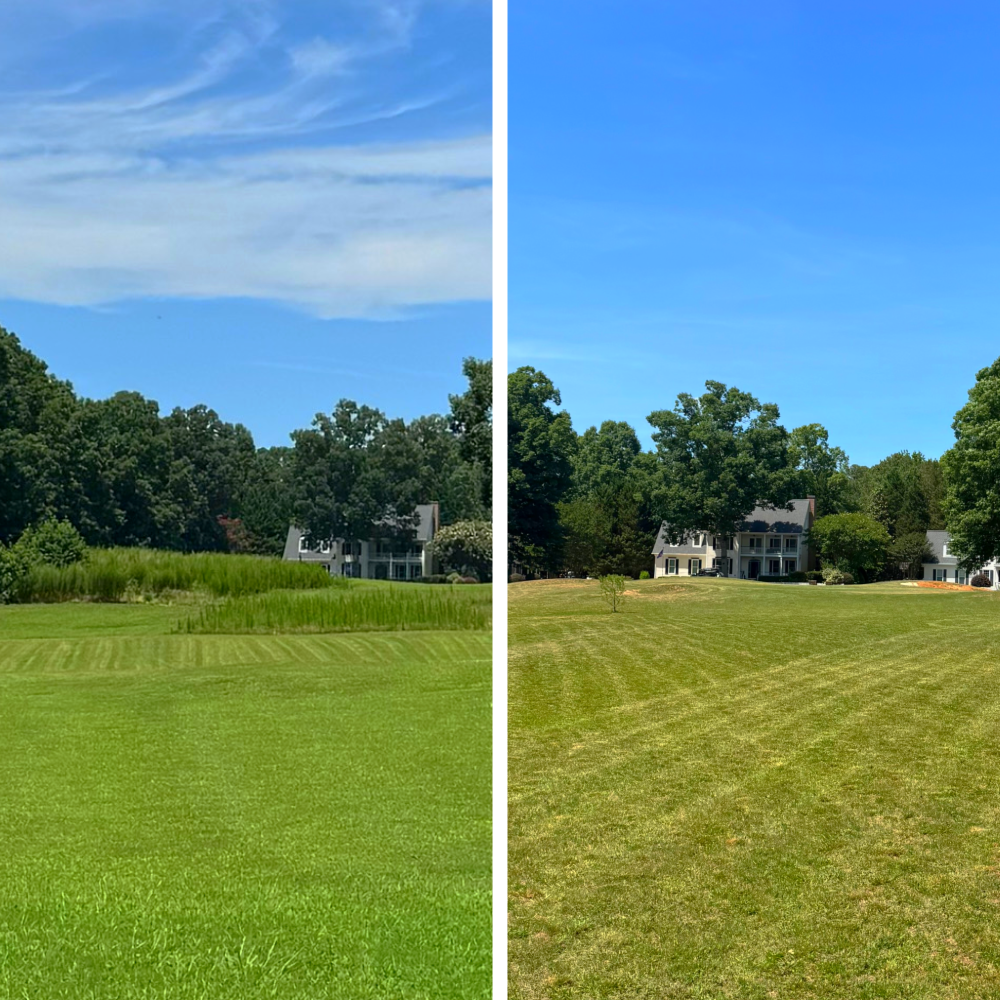
Before/After July 2025/May 2026
I was writing about clearing the overgrowth first: removing the friction, the misalignment, and the tangled history before attempting any bold moves.
I had named two pieces of the cycle before I knew it was a cycle.
That’s usually how reinvention works.
You’re living the pattern well before you can see its shape.
If you’re reading this and something in it landed a little too cleanly; if you recognized that quiet, I want to offer you one reframe to sit with:
The friction you’re feeling is probably not a sign that you’ve lost it.
It’s more likely a sign that you’ve outgrown the version of yourself that got you here.
That’s not failure.
In the cycle, that’s the part right before everything gets interesting.
Reinvention doesn’t start with a new title or a grand plan.
It starts the same way a round of golf does.
One honest step toward a target you can’t fully see yet, taken anyway.
That’s the work I do with leaders sitting at exactly that turning point: helping them tell the difference between friction and decline and move through the cycle on purpose rather than by accident.
If that’s where you are, I’d welcome a conversation.
